

My 20-year journey to a sarcoidosis diagnosis

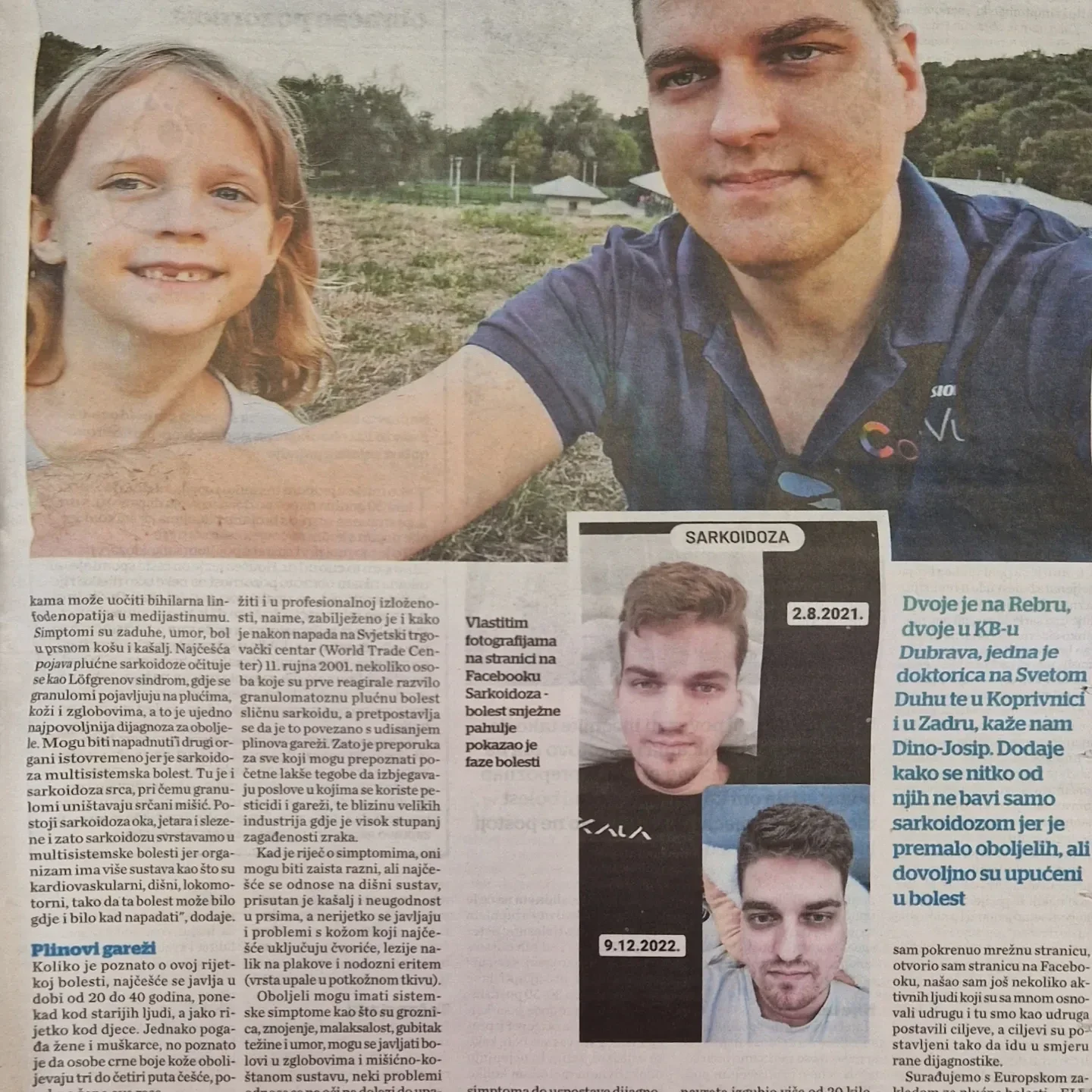
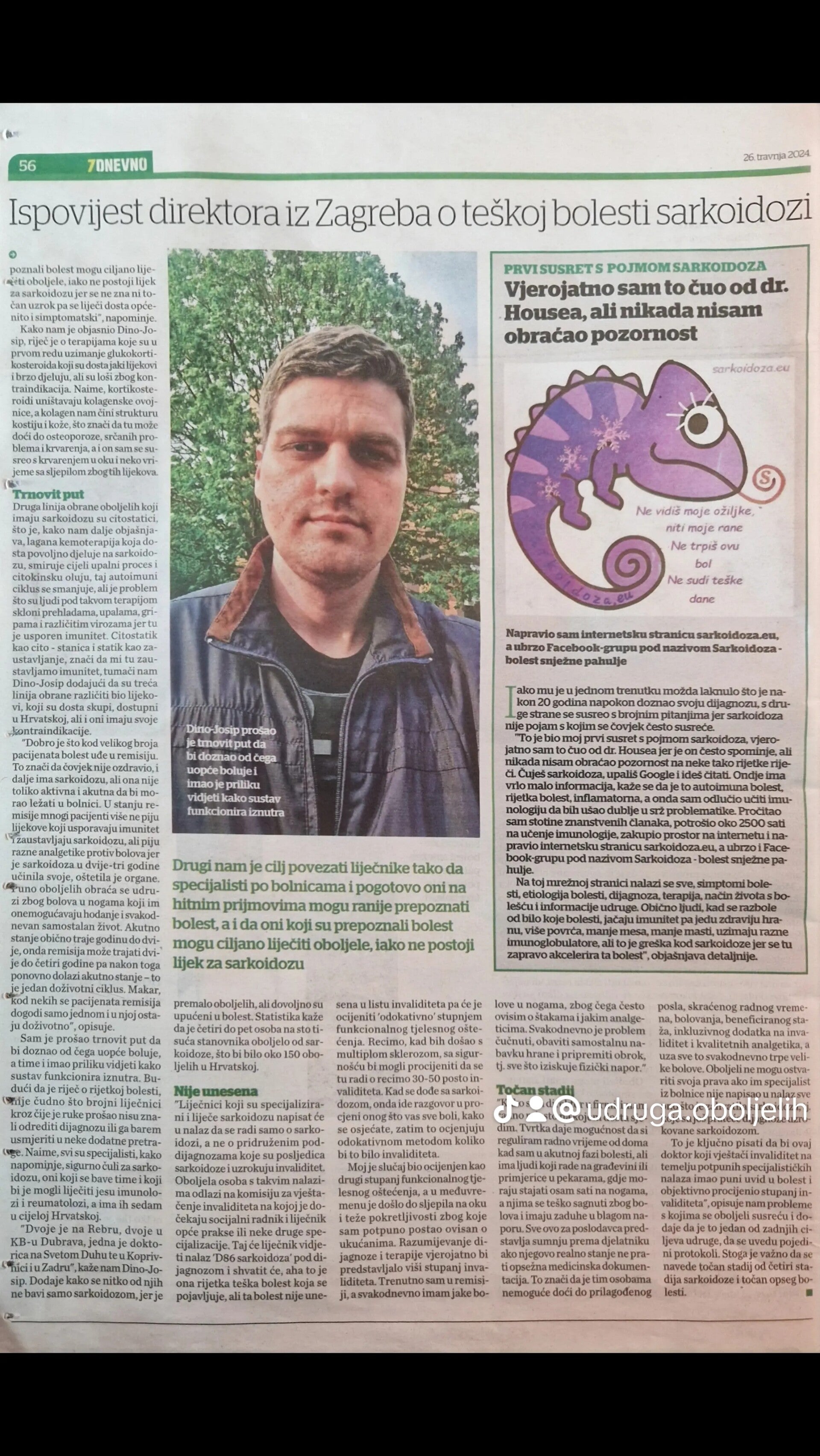
Interview about sarcoidosis in the newspaper 7dnevno, 24 April 2024.
MY STRUGGLE: A FULL 20 YEARS TO REACH A DIAGNOSIS
It is certainly not pleasant for anyone to discover that they have a disease about which even doctors know little. If we add the fact that some people spend years visiting numerous healthcare institutions before finding out what is wrong with them, it is difficult even to imagine the agony that patients go through. The symptoms are there, pain appears too, but there is no solution.
One person who has experienced such a story first-hand is Dino-Josip Ključarić, a 43-year-old man from Zagreb who has sarcoidosis. Many people have heard of the disease while watching Dr House, who would sometimes use this “label” for patients whose illness he could not work out.
It all began during his student years, and a full 20 years had to pass before a diagnosis was reached. Those 20 years contained numerous visits to doctors and emergency departments, unexplained pain, and, worst of all, uncertainty about what was happening inside his body. After such a long time, it is hardly surprising that many patients begin to wonder whether the problem lies with them and whether it is all psychological. Dino-Josip faced these difficulties too. He decided to take matters into his own hands and spend a great many hours learning everything about sarcoidosis. He then founded an association whose goals include educating students so that, one day, they will have a better understanding of this disease and be able to recognise it as early as possible.
“During my studies, when I was 18 or 19, I sometimes limped because of pain in my ankles or knees. The limp was caused by strange pains, as though you had a thorn in your heel and a cutting sensation below the kneecap, but there was actually no thorn. It would come and go, but I did not connect it with a disease because I was an active swimmer and thought it was due to too much exercise.
Over the next five years, I would sometimes have strange symptoms such as sweating at night. My pyjamas would be completely wet. These were really heavy night sweats, and it is important to point out that this is a very common symptom of sarcoidosis, but I did not know that then,” Dino-Josip explains, telling us how it all began.
The years passed, and new health problems appeared during that time. Yet despite visits to doctors and even trips to the emergency department, he would regularly end up back at home as though nothing had happened.
“In my thirties, I began to experience breathlessness and various pains around the sternum, the bone in the chest to which the ribs attach. These pains were similar to a heart attack because they were intense and sharp. There was pressure accompanied by discomfort and such severe weakness that I could not manage three or four steps. When I went to the emergency department, they found no changes, nothing to suggest that I had an illness for which they needed to keep me in. I would go home, and by then I had already begun to think that perhaps it was psychological,” he added.
His health fluctuated, and in an effort to discover what was wrong, he also visited private healthcare institutions, but that did not yield any results either.
“I fought for my life in 2009 when I developed sepsis, but its cause was unknown too. It was only three years ago, after erythema nodosum appeared, that I ended up in the emergency department and was diagnosed with an acute phase of sarcoidosis during my hospital stay. I had developed lumps on my lower legs and muscles that looked like bruises and bites, like those left by a spider or mosquito. There were around twenty lumps on each lower leg, along with swollen ankles, which they call erythema nodosum.
Before being admitted to hospital, I had various tests done privately to speed things up, but nothing was known. When I began to suffocate, when the severe pain started, as though someone were driving a spear through my chest, my children called an ambulance. I ended up at Rebro, where they did a brain CT scan, said it was not any kind of cancer, and sent me to the Covid centre in Dubrava. This was still during the coronavirus period. There, in five days, they performed a bronchoscopy, a lung biopsy, an EBUS examination, a biopsy of my leg muscles, skin and bone marrow biopsies, a colonoscopy and a gastroscopy. They examined my optic nerves and concluded that it was sarcoidosis,” Dino-Josip tells us, recalling how he finally learned his diagnosis.
Although he may initially have felt relieved to have finally learned his diagnosis after 20 years, he also found himself facing many questions, because sarcoidosis is not a term one normally comes across in life.
“That was my first encounter with the term sarcoidosis. I had probably heard it on Dr House, since he mentions it often, but I had never paid attention to unusual words like that. You hear ‘sarcoidosis’, open Google and start reading. There is very little information there. It says that it is an autoimmune disease, a rare disease, an inflammatory disease. Then I decided to study immunology to get deeper into the heart of the problem. I read hundreds of scientific articles, spent about 2500 hours studying immunology, bought web hosting and created the website sarkoidoza.eu, and soon afterwards a Facebook group called Sarkoidoza - bolest snježne pahulje.
That website covers everything from the symptoms and aetiology of the disease to diagnosis, treatment, living with the disease and information about the Association. Usually, when people develop any illness, they boost their immunity, so they eat healthier food, more vegetables, less meat and less fat, and take various ‘imuno globulatore’. But this is a mistake with sarcoidosis because it actually accelerates the disease,” he explains in more detail.
The knowledge he gained on his own by actively studying immunology showed him otherwise. “Sarcoidosis is not an autoimmune disease, but an inflammatory disease. Sarcoidosis is not a contagious disease; it is triggered by external influences and a genetic predisposition. An antigen enters the body. It is essentially a foreign molecule which, once it enters the body, sets off a whole series of defence mechanisms that we possess through innate or acquired immunity. The activation of defence mechanisms in response to the entry of that foreign body, the antigen, is called a trigger. Thus, the trigger for a viral illness is a virus, for bacterial inflammation a bacterium, and for an allergy an allergen... In sarcoidosis, research into defence mechanisms within the immune response has established that the trigger, or the factor that sets off the disease, is most likely some ‘propriobakterija’, a virus or a toxin. Our antibodies (macrophages and dendritic cells), which serve to defend us against antigens, present the antigen to the immune system as a danger and send cytokines that initiate the entire immune response. In sarcoidosis, an unknown reaction occurs because the defence cells present a type of information at the site of the antigen that tells our immune system that our own cells are a foreign body. Inflammation then develops as clusters of our defensive lymphocytes form granulomas. Such granulomas can develop in any organ. In this way, this inflammatory disease, caused by external factors and a genetic predisposition, behaves like an autoimmune disease. Current research links high levels of stress to one of the contributing triggers of inflammatory and autoimmune diseases. Stress raises cortisol levels, which can weaken your immune system if they remain high for too long. Stress can also damage your body's own cells and even trigger reactions in your immune system, including increased inflammation, which can make you more susceptible to viruses and infections. Restoring physiological cortisol production can therefore be linked to an immune reaction leading to the development of autoimmune diseases. The specific biomarkers ACE and chitotriosidase, measured in blood tests, will show that it is sarcoidosis. A biopsy of the granulomas also establishes a threefold disproportionate ratio of CD4 and CD8 lymphocytes, confirming the diagnosis of sarcoidosis.
In most patients, sarcoidosis manifests in the lungs, so bilateral hilar lymphadenopathy in the mediastinum can already be seen on X-rays. The symptoms are breathlessness, fatigue, chest pain and coughing. The most common presentation of pulmonary sarcoidosis is Löfgren's syndrome, in which granulomas appear in the lungs, skin and joints. This is also the most favourable diagnosis for patients. Other organs can be affected at the same time because sarcoidosis is a multisystem disease. There is also cardiac sarcoidosis, in which granulomas destroy the heart muscle. There is sarcoidosis of the eyes, liver and spleen, which is why we classify sarcoidosis as a multisystem disease. The body has several systems, such as the cardiovascular, respiratory and locomotor systems, so this disease can strike anywhere and at any time,” he adds.
This chronic inflammatory disorder is characterised by the accumulation of granulomas in various body tissues. Granulomas are clusters of inflammatory white blood cells that form non-cancerous nodules and interfere with normal tissue function. From what is known about this rare disease, it most often appears between the ages of 20 and 40, sometimes in older people and very rarely in children. It affects women and men equally, but it is known that Black people develop it around three to four times more often, especially women of this race.
The cause of this disease remains unknown. The triggers are believed to be environmental antigens that initiate an immune response, resulting in inflammatory granulomatous reactions. Although sarcoidosis cannot be classified as an infectious process, it is important to note that viruses, for example, can provoke an excessive immune response.
Some triggers may also arise from occupational exposure. It has also been recorded that, after the attacks on the World Trade Center on 11 September 2001, several first responders developed a granulomatous lung disease resembling sarcoidosis, and a connection with inhaling gases and soot is suspected. The recommendation for anyone who recognises the first mild symptoms is therefore to avoid work involving pesticides and soot, as well as proximity to large industrial facilities where air pollution levels are high.
As for symptoms, they can be very varied, but they most often affect the respiratory system in the form of a cough and chest discomfort. Skin problems are also fairly common, most often including nodules, plaque-like lesions and erythema nodosum, a type of inflammation in the tissue beneath the skin.
Patients can have systemic symptoms such as fever, sweating, weakness, weight loss and fatigue. Joint and musculoskeletal pain can occur, and some problems affect the eyes, causing eye inflammation, dryness and blurred vision.
However, lung involvement has been recorded in more than 90 per cent of asymptomatic patients and can be identified on an X-ray. These patients develop “hilar adenopathy”, meaning swelling of the lymph nodes in the chest, with or without additional lung findings, and may also show abnormal liver test results.
“Twenty years passed between the first symptoms and the diagnosis, with suffering and problems that were sometimes severe and sometimes temporary. When you spend 20 years visiting doctors whose training mentioned sarcoidosis once, perhaps in an overview of pathology, they have been unable to recognise those symptoms, so patients often feel like hypochondriacs. They feel pain, see that something is troubling them, and notice a loss of body weight and strength. I, for example, lost more than 20 kilograms on three occasions, and the cause was unknown,” this man from Zagreb tells us, revealing the painful side of the whole story.
But the disease did not discourage him. Instead, it gave him additional strength to learn as much as possible about it and to help everyone fighting the disease, as well as those who will encounter it in the future.
“After launching the website, I opened a Facebook page and found a few more active people who founded the Association with me. As an Association, we set goals geared towards early diagnosis. We cooperate with the European Lung Foundation, ELF, and the medical faculty, and give lectures to students. We also work with immunologists because, ultimately, a doctor should have the final word, someone who deals with sarcoidosis. Our second goal is to connect doctors so that specialists in hospitals, particularly those in emergency departments, can recognise the disease earlier, and so that those who have recognised it can provide targeted treatment. This is despite the fact that there is no cure for sarcoidosis, since even its exact cause is unknown, so treatment is quite general and symptomatic,” he points out.
As Dino-Josip explained to us, the treatments primarily involve taking glucocorticosteroids, which are quite powerful, fast-acting medicines but are problematic because of their contraindications. Corticosteroids destroy collagen sheaths, and collagen forms the structure of our bones and skin, which means that osteoporosis, heart problems and bleeding can occur. He himself experienced bleeding in his eye and blindness for a time because of these medicines.
The second line of defence for patients with sarcoidosis is cytostatic drugs. As he goes on to explain, this is mild chemotherapy that has quite a beneficial effect on sarcoidosis, calming the entire inflammatory process and the cytokine storm and reducing that autoimmune cycle. The problem is that people receiving such treatment are more susceptible to colds, inflammation, influenza and various viral illnesses because their immunity is slowed down. In the word cytostatic, “cyto” means cell and “static” means stopping, so we are stopping immunity, Dino-Josip explains. He adds that the third line of defence consists of various biological medicines, which are quite expensive and available in Croatia, but also have their own contraindications.
“The good thing is that the disease goes into remission in a large number of patients. This means that the person has not recovered and still has sarcoidosis, but it is not so active and acute that they have to be in hospital. During remission, many patients no longer take medicines that slow down immunity and stop sarcoidosis, but they take various painkillers because, over two or three years, sarcoidosis has taken its toll and damaged their organs. A great many patients contact the Association because of leg pain that prevents them from walking and living independently day to day. The acute phase usually lasts one to two years, then remission can last two to four years, after which the acute phase returns. It is a lifelong cycle. However, some patients enter remission just once and remain in it for the rest of their lives,” he tells us.
He himself travelled a difficult road to find out what illness he had, which also gave him the opportunity to see how the system works from the inside. Since it is a rare disease, it is not surprising that many of the doctors he saw were unable to make a diagnosis or at least refer him for further tests. As he points out, all specialists have certainly heard of sarcoidosis. Those who deal with it and could treat it are immunologists and rheumatologists, and there are seven of them in the whole of Croatia. Two are at Rebro, two at Dubrava Clinical Hospital, one female doctor is at Sveti Duh, and there are also doctors in Koprivnica and Zadar, Dino-Josip tells us.
He adds that none of them deals exclusively with sarcoidosis because there are too few patients, but they know enough about the disease. Statistics say that four to five people per hundred thousand inhabitants have sarcoidosis, which would mean around 150 patients in Croatia.
“Emergency departments mainly employ young doctors who are still undergoing specialist training, so it will be very difficult for them to recognise sarcoidosis. That is why we started educating students. Another issue is that doctors who specialise in and treat sarcoidosis will write in the report that it is simply sarcoidosis, without listing the associated secondary diagnoses that result from sarcoidosis and cause disability. A patient takes these reports to a disability assessment board, where they meet a social worker and a general practitioner or a doctor from another speciality. That doctor will see ‘D86 sarcoidosis’ under the diagnosis in the report and think: ah, that is the serious rare disease that occurs. But this disease is not included on the disability list, so they will estimate a degree of functional physical impairment by rough judgement. For example, if I came with multiple sclerosis, they could confidently assess it as, say, 30–50 per cent disability. When you come with sarcoidosis, there is an interview to assess everything that hurts and how you feel, and then they make a rough estimate of how much disability that would amount to. My case was assessed as second-degree functional physical impairment, but in the meantime I became blind in one eye and developed greater difficulty moving, which made me completely dependent on members of my household. Understanding the diagnosis and treatment would probably mean recognising a higher degree of disability. I am currently in remission, but I have severe leg pain every day, which means I often depend on crutches and strong painkillers. Every day it is a problem to squat down, buy food independently and prepare a meal, in other words, anything that requires physical effort.
As I am a company director, I have a job that involves a lot of sitting. The company allows me to arrange my working hours from home when I am in the acute phase of the disease. But there are people who work in construction or, for example, in bakeries, where they have to spend eight hours on their feet. They find it difficult to bend down because of pain and become breathless with mild exertion. All this makes an employer suspicious of an employee if their actual condition is not backed up by extensive medical documentation. This means that it is impossible for these people to obtain adapted work, reduced working hours, sick leave, enhanced pensionable service, the inclusive disability allowance and effective painkillers, while also enduring severe pain every day. That burden falls directly on their families. Patients cannot exercise their rights if the hospital specialist has not written in the report everything that sarcoidosis has affected, meaning the other accompanying diagnoses caused by sarcoidosis. It is essential to write this down so that the doctor assessing disability has a full picture of the disease, based on complete specialist reports, and can objectively assess the degree of disability,” he says, describing the problems patients encounter. He adds that introducing certain protocols is one of the Association's final goals. It is therefore important to state exactly which of the four stages of sarcoidosis is present and the precise extent of the disease.
The website of the Association of patients with sarcoidosis contains a wealth of important information for patients and their families. Although the Association was founded only in January of this year, it can truly be proud of its dedicated work and persistence. Its four main goals are to raise public awareness of sarcoidosis, connect doctors for early diagnosis and comprehensive assessment of patients, support patients and their families, and secure social rights for those more severely affected. It is a place that brings together personal experiences, patients' stories and all information related to treatment, because becoming informed about this rare disease is the first step for anyone who encounters it. Anyone wishing to support the work of this Association can do so by making a payment
to IBAN: HR1724020061101204832.
Source 2: