

Schematic representation of the causes of sarcoidosis at the cellular level
How sarcoidosis develops
In this text, you can see the connection between the development and outcome of sarcoidosis at the cellular level.
I will simplify this in lay terms, and anyone interested can read more:
1. A foreign body enters the body. We call this body an antigen. It most likely enters through the air, that is, aerobically.
2. The immune system responds "too aggressively", meaning that the small cells (macrophages) responsible for "eating" the foreign body come together to form an inflammatory cluster, that is, they create granulomas. In the process of defence, these macrophages calcify healthy tissue, so for this reason WE MUST NOT TAKE CALCIUM OR VITAMIN D (without a doctor’s supervision), NOR BOOST OUR IMMUNITY.
Lymph, whose task is to remove toxins and reduce inflammation, swells as it encounters granulomas.
Treatment with glucocorticosteroids aims to reduce the inflammatory process, while treatment with cytostatic drugs (mtx) "slows down" the speed of immunity and the immune response.
The description follows:
Exposure of the body to an unknown sarcoid antigen leads to the activation of T cells and APCs, which leads to the release of cytokines. CD4 activation can skew the immune system towards a Th1 and Th2 response, which in turn induces granuloma formation. In later stages, granuloma formation can lead to regression or a chronic disease state with fibrosis.
A granuloma is a term used to describe a type of inflammation that occurs in response to various triggers, such as infections, foreign bodies or autoimmune disorders.
This condition is characterised by the formation of small clusters of cells that can develop in different parts of the body, including the lungs, skin and digestive system.
Granulomas consist of immune cells, such as macrophages, which accumulate in a particular area in response to a stimulus.
Sarcoid granuloma: It can develop in several organs of the body, including the lungs, lymph nodes and skin. The cause of sarcoidosis is not sufficiently understood, but it is believed to be an autoimmune disorder in which the body’s immune system attacks its own tissues. Sarcoid granulomas can cause a range of symptoms, such as cough, difficulty breathing and skin lesions.
Macrophages are a type of leukocyte cell in the human (and animal) body, microscopically larger than neutrophilic leukocytes, whose main task is to clear the body of waste substances and fight foreign substances (antigens).
They arise from blood monocytes, which in turn arise in the bone marrow and have characteristic morphological features. Macrophages are unfortunately responsible for anthracosis and asbestosis, because they move chemotactically towards inflammatory interleukins (e.g. IL-1) and areas of inflammation and "eat" (Greek phagein > phag, meaning to eat) foreign particles, resulting in pulmonary anthracosis (they are unable to break down the contents). Unfortunately, they also participate in the process of atherosclerosis ("foam cells"). They are found as an integral component of many organs.
The function of macrophages comes down to "eating" foreign substances. This is called phagocytosis.
TNF-alpha
Macrophages secrete plasminogen activator, which is important in the blood-clotting system; they secrete serine proteases and other enzymes, various interleukins and tumour necrosis factor alpha (TNF-alpha).


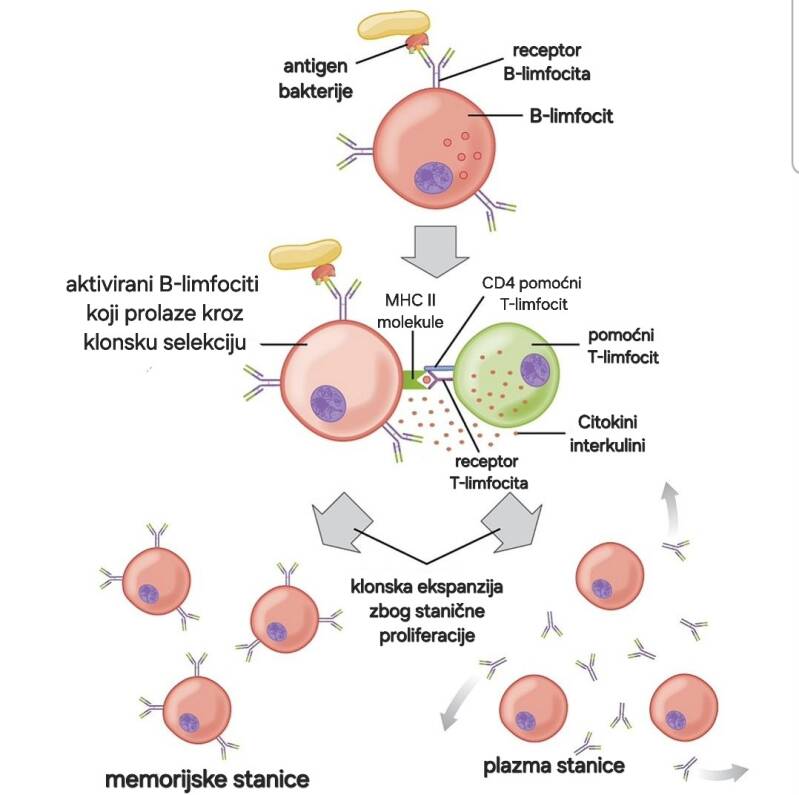
the image shows the mechanism of the immune response:
-a bacterial antigen is recognised by the B-lymphocyte receptor
- the B-lymphocyte cell is activated
-the MCH II molecule presents the processed antigen in a specific manner of immune response
- the B-lymphocyte cell presents the bacterial antigen and secretes cytokines
- cytokines activate memory lymphocytes according to the antigen-receptor key
-specific lymphocytes that attack bacteria are cloned
MCH II
Macrophages and dendritic cells (DC) are antigen-presenting cells that constitutively express MHCII under steady-state conditions.
MHC class II molecules are expressed at high levels on activated T cells.
The MHC class II protein complex is encoded by the human leukocyte antigen (HLA) gene complex.
The most important function of the human leukocyte antigen (HLA) molecule is the induction and regulation of immune responses and the selection of the T-lymphocyte repertoire.
In sarcoidosis and other autoimmune diseases, this function of the human leukocyte antigen molecule is crucial in detecting an incorrect immune response.
Dino-Josip Ključarić