Can the heating season and air pollution trigger acute sarcoidosis earlier?
Translation of the original Croatian article
Read this interesting article, which draws on 25 years of research involving almost 200 patients to link the triggering of acute sarcoidosis to air pollution during the heating season.
Although this correlation has not yet been firmly established, there are strong associations between air pollution and the onset of the acute phase of sarcoidosis.
Interestingly, in colder countries, where cold periods cause the heating season to start earlier, the acute phase of the disease is triggered earlier.
Read the summary:
Acute sarcoidosis clusters in the cold season and is associated with air pollution: a retrospective clinical-meteorological study
...Risk factors for sarcoidosis include exposure to airborne particles through, for example, metalworking, employment in transport services, and exposure to plant dust or wood burning. The increased incidence of sarcoidosis among firefighters, as well as its high incidence among individuals exposed to the collapse of the World Trade Center, further point to the involvement of particles in its pathogenesis.
The main manifestations in the lungs and skin, certain at-risk populations, and seasonal clustering suggest the importance of seasonal airborne antigens in acute sarcoidosis. We hypothesized that air pollution plays a role in acute sarcoidosis and its seasonal clustering and north–south gradients.
For this retrospective medical-record review, we searched the records of the University Medical Center Freiburg for all patients in the region of Baden-Wuerttemberg, Germany, diagnosed with acute sarcoidosis, defined as bilateral hilar lymphadenopathy in combination with ankle swelling and/or erythema nodosum plus a corresponding physician's diagnosis. Disease onset was set as the date of the first symptoms (month/year). The study was approved by the local ethics committee of the University of Freiburg (approval number: 11/19). Data on measured concentrations of particles ⩽10 μm in aerodynamic diameter (PM10) and nitrogen dioxide (NO2) were provided by the State Institute for the Environment, Measurements and Nature Conservation of Baden-Wuerttemberg. Monthly medians of the air-pollutant time series were calculated from hourly NO2 concentrations measured at 27 stations and daily PM10 concentrations available from 38 stations in southwestern Germany. Air-temperature data for the same area were obtained from the Climate Data Center of the German Weather Service.
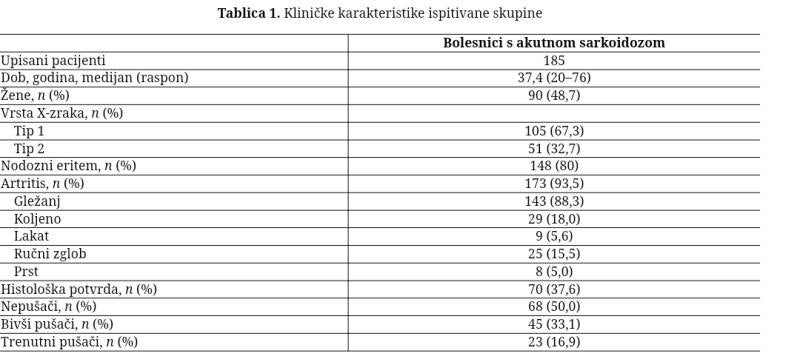
Over a period of 25 years (1994–2018), we identified 185 patients diagnosed with acute sarcoidosis; 136 (73.5%) displayed the complete Löfgren triad; see Table 1 for a detailed description of the study population. Disease onset showed a seasonal pattern: symptoms began mainly in the first half of the year (73.5% of cases), peaking in January. Particularly high incidence was recorded in the first third of the year (January 17.8%; February 11.3%; March 12.4%; April 13.0%; total 54.5%), as shown in Figure 1. The monthly median PM10 concentration was highest from December to April, with values ranging from 15 to 40 μg/m³. The monthly median NO2 concentration was highest from November to March (45 μg/m³) and lowest from April to August (25 μg/m³), as shown in Figure 2A. Monthly sarcoidosis incidence correlated with the course of PM10 and NO2, with cross-correlation coefficients ranging from 0.7 to 0.9 (see Figure 2C). Time-series analysis over 17 years (2000–2016) showed that the highest number of acute sarcoidosis cases is reached shortly after the particulate-matter peak (median time lag between maxima within each year, 4 weeks; range, -8 to 20 weeks; Figure 2A) and the minimum air temperature (cross-correlation coefficients, 0.4–0.9; mean time lag, 12 weeks; range, 0 to 44 weeks; Figure 2B).
This is the first demonstration of an association between the seasonal dynamics of air temperature, air pollution, and the incidence of acute sarcoidosis. The importance of air pollution in the pathogenesis of sarcoidosis is indicated by at-risk populations (for example, firefighters and those exposed to plant dust, wood burning, etc.); observations of regional sarcoidosis clusters in areas with intensive metalworking industries, agriculture, or heavy traffic; studies of the World Trade Center; and case reports describing sarcoidosis following intense dust exposure. Furthermore, patients with sarcoidosis have reported increased severity of respiratory symptoms following short-term exposure to polluted air. In clinical practice, we have also seen patients who developed acute sarcoidosis days after cleaning a pellet-storage facility, after demolition work near their homes, or after cleaning attics without dust masks. Air pollution has been described as a risk factor for disease, with adverse health effects present even at low concentrations. Particles are directly associated with the development of respiratory diseases and malignancies and play a potential role in autoimmune disorders.
We found a pattern of acute sarcoidosis onset comparable to those in northern European countries, whereas incidence peaks later in the year in Mediterranean countries. Thus, in colder regions, sarcoidosis incidence might peak earlier, for example because of an earlier start to the heating period. Domestic stoves are a major source of particles, and their emissions can affect human health. Consistent with these observations, low air temperature was associated with increased sarcoidosis incidence in our study.
...Overall, our study suggests that air pollution plays a role in the etiology of acute sarcoidosis and provides a possible explanation for seasonal clustering, the north–south gradient, and at-risk populations. Sentence restored from the cited original study: Although PM2.5 is usually used to estimate the burden of air pollution on population health, PM10 can be considered a valid proxy for PM2.5 because of the strong correlation between them.
Table translation

Tablica 1. Kliničke karakteristike ispitivane skupine → Table 1. Clinical characteristics of the study group
Bolesnici s akutnom sarkoidozom → Patients with acute sarcoidosis
- 1. Upisani pacijenti → Enrolled patients: 185
- 2. Dob, godina, medijan (raspon) → Age, years, median (range): 37,4 (20–76)
- 3. Žene, n (%) → Women, n (%): 90 (48,7)
- 4. Vrsta X-zraka, n (%) → X-ray type, n (%)
- 5. Tip 1 → Type 1: 105 (67,3)
- 6. Tip 2 → Type 2: 51 (32,7)
- 7. Nodozni eritem, n (%) → Erythema nodosum, n (%): 148 (80)
- 8. Artritis, n (%) → Arthritis, n (%): 173 (93,5)
- 9. Gležanj → Ankle: 143 (88,3)
- 10. Koljeno → Knee: 29 (18,0)
- 11. Lakat → Elbow: 9 (5,6)
- 12. Ručni zglob → Wrist: 25 (15,5)
- 13. Prst → Finger: 8 (5,0)
- 14. Histološka potvrda, n (%) → Histological confirmation, n (%): 70 (37,6)
- 15. Nepušači, n (%) → Non-smokers, n (%): 68 (50,0)
- 16. Bivši pušači, n (%) → Former smokers, n (%): 45 (33,1)
- 17. Trenutni pušači, n (%) → Current smokers, n (%): 23 (16,9)