

Heerfordt-Waldenström syndrome (HWS)
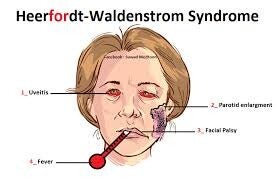
Heerfordt-Waldenström syndrome (HWS) is a rare form of sarcoidosis characterized by enlargement of the parotid gland, facial nerve paralysis, anterior uveitis and fever.
Waldenström syndrome is a rare form of sarcoidosis. It was first described by Dr. Christian Heerfordt in the early 1900s, and Dr. Waldenström later linked it to sarcoidosis. Only a few cases of this syndrome have been recorded worldwide.
Clinical presentation
The clinical presentation ranges from asymptomatic disease to acute disease, to chronic, insidious organ failure.
The literature reports that it occurs in about 0.3% of sarcoidosis cases.
Facial nerve paralysis is an integral component of this syndrome, with an incidence of 25-50%. Parotid gland involvement occurs in about six percent of cases and is usually bilateral. Most patients have a low-grade fever. Eye involvement occurs in about 11-83% of patients, most commonly with anterior uveitis, together with increased tearing, photophobia and blurred vision.
Signs
Enlargement of the parotid gland, peripheral facial paralysis and anterior uveitis. Asymptomatic conjunctival nodules may be present.
Differential diagnosis
Tuberculosis
Sjögren’s syndrome
Bell’s palsy associated with herpes simplex virus
Ramsay-Hunt syndrome associated with varicella zoster virus
Treatment
Treatment with corticosteroids will usually lead to resolution of facial nerve paralysis, uveitis and parotid gland swelling. Alternative medications such as methotrexate, azathioprine, infliximab or mycophenolate mofetil may be given to patients who do not respond to corticosteroids or who cannot tolerate steroids. It should be emphasized that these agents are generally added in steroid-resistant cases and are not started at the outset.
Prognosis
It is usually self-limiting, with a cure achieved between 12 and 36 months, although some prolonged cases have been reported. The likelihood of permanent paralysis increases in patients who are not treated with corticosteroids. The mortality rate ranges between 1 and 5% of cases.
Source: https://www.ncbi.nlm.nih.gov/pmc/articles/PMC7515795/
-Waldenstr%C3%B6m_Syndrome