NEUROSARCOIDOSIS
Sarcoidosis can occur in almost any organ. In 5 to 15% of patients with sarcoidosis, the disease occurs somewhere in the nervous system. This is called neurosarcoidosis.
The nervous system
The nervous system is made up of the central and peripheral nervous systems. The brain and spinal cord form the central nervous system. The peripheral nervous system consists of nerves and peripheral nerves in the brain (cranial nerves).
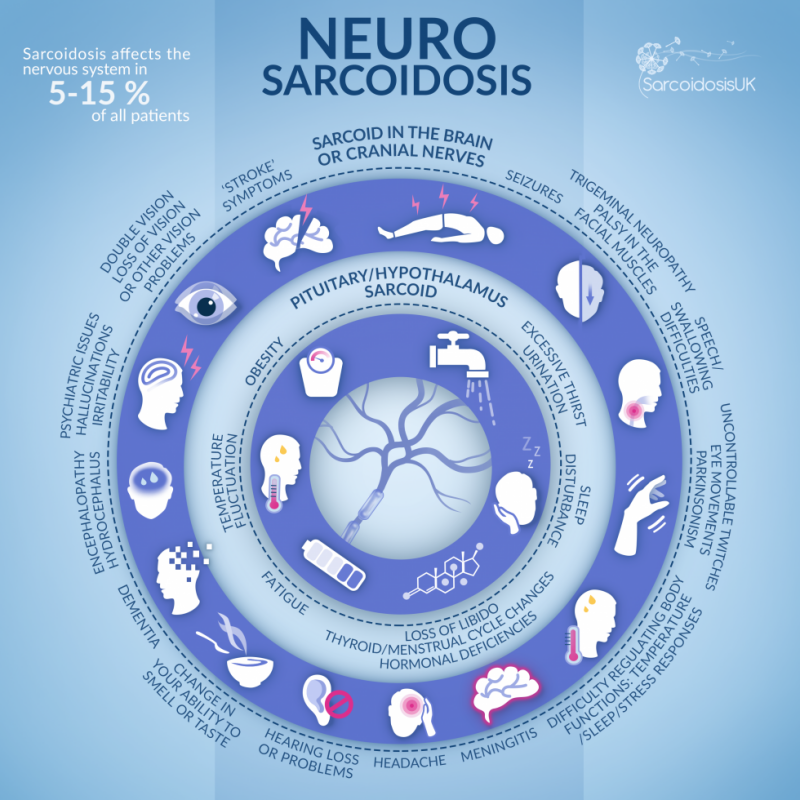
The cranial nerves control the eye muscles, the muscles of the face and tongue, and the muscles used for swallowing. The cranial nerves provide the senses of smell, sight, taste, hearing and touch.
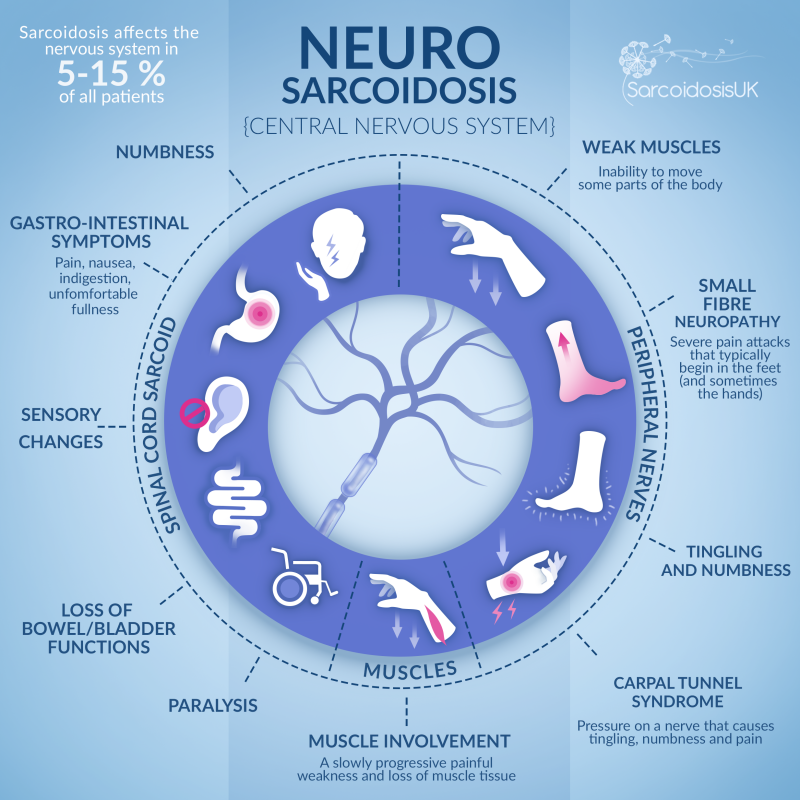
Peripheral nerves extend from the spinal cord to the torso, arms and legs, and to the internal organs. A particular type of peripheral nerve can be referred to as small nerve fibres. Sometimes the muscles are also included in the peripheral nervous system.
Sarcoidosis in the nervous system
Sarcoidosis can occur in almost any organ. Sarcoidosis affects the nervous system in 5% to 15% of all patients (neurosarcoidosis). Neurosarcoidosis is therefore uncommon (only 20 cases per million people), but it can be severe. Nevertheless, with specialist care, the disease is usually easy to treat. Only a minority of patients suffer permanent neurological damage.
The disease can affect any part of the nervous system. It does this by causing granulomatous inflammation (it affects other organs, such as the lungs, skin and liver, in the same way). Symptoms, diagnosis and treatment options depend on which part of the nervous system is inflamed. The main types of neurosarcoidosis are listed below. Patients are sometimes affected by more than one type.
Cranial neuropathy
Half of all patients with neurosarcoidosis have a simple cranial neuropathy, such as weakness of one half of the face. Sometimes other nerves are affected, causing hearing problems, facial numbness, tongue weakness, difficulty swallowing or double vision. Patients with cranial neuropathies respond well and quickly to steroids, and the condition usually resolves completely.
Other forms of neurosarcoidosis
Of the remaining half of patients, two thirds have leptomeningitis, one quarter have pachymeningitis, and the rest have the vasculitic form. These cases are much more serious and require urgent assessment and treatment:
1. Leptomeningitis
In this process, the inner lining of the brain becomes inflamed, and the inflammation quickly spreads into the brain, which itself swells. This can cause a wide range of symptoms, depending mainly on the point of entry and the severity of the inflammation. Most patients develop headache, drowsiness and slowed thinking, followed by other features such as weakness or numbness, and problems with balance, vision and hearing. The MRI scan is always abnormal, and the spinal fluid shows inflammatory cells.
2. Pachymeningitis
The outer lining of the brain or spinal cord becomes inflamed. This causes headaches and focal neurological signs, such as weakness or numbness on one side, and occasionally seizures. Patients have abnormal brain scans and may occasionally be misdiagnosed with a brain tumour because of what is shown on the scan.
Vasculitis. This is the rarest form of neurosarcoidosis and is caused by inflammation within the blood vessels of the brain. The blood vessels can become blocked, and small areas of inflammation can be seen on the surface of the brain on MRI scans. Sometimes vasculitis on a scan can be misinterpreted as a stroke or multiple sclerosis. Occasionally, the blood vessels can become narrowed and distorted.
Diagnosis can usually be made after blood and spinal fluid tests and MRI scanning, but occasionally a biopsy of the brain or spinal cord is necessary.
It is treated with high-dose steroids, suppression of the immune system with chemotherapy, and immunotherapy drugs such as infliximab. Treatment is needed for at least 5 years. Most patients respond well to this medication, but they need to be monitored carefully and, most importantly, by a neurologist experienced in this disease. This should take place within a multidisciplinary team consisting of respiratory physicians, rheumatologists, endocrinologists, immunologists and specialist nurses.
Peripheral neuropathies
When the peripheral nervous system (the nerves of the body) is involved, a condition known as peripheral neuropathy can develop. This occurs in about 10% of patients and causes numbness and occasionally weakness of the hands and feet. It is usually painless and mild, and does not worsen.
Some patients may have a serious problem known as acute demyelinating polyradiculoneuropathy, which develops at the onset of systemic disease, but improves with treatment. Some develop mononeuropathies when only one nerve is affected, for example in the arm.
Small fibre neuropathy
Small fibre neuropathy is common; patients complain of burning sensations in their feet and sometimes also in their hands. In most patients, the condition is irritating but does not worsen, although in some it can be very serious and painful. Treatment is always helpful; drugs for neuralgia (such as gabapentin and duloxetine) work well, and those with severe pain respond to infliximab.
Polymyositis and muscle pain
When a muscle is affected, it can be painful and cause weakness; this is known as polymyositis. It can also be a slowly worsening problem with muscle wasting that does not cause pain. The polymyositis form responds to treatment, but the rare muscle-wasting form does not. Muscle involvement occurs in only 5% of cases.
Techniques for understanding your condition
If your symptoms suggest neurosarcoidosis, your doctor will refer you to a neurologist. This doctor will map out the neurological signs and symptoms. A physical examination is always part of a consultation with a neurologist. If necessary, they will also arrange additional tests such as EEC (Electroencephalo Gram) and MRI (Magnetic Resonance Image).
Early diagnosis
The effectiveness of treatment for severe forms of neurosarcoidosis can be considerably improved by early and aggressive treatment following assessment at specialist centres. Patients must make sure that their doctors understand neurosarcoidosis sufficiently well. SarcoidosisUK can help them find units that provide specialist care.
Summary
The earlier treatment is given, and the stronger the treatment used for that situation, the more likely patients are to respond well and regain reasonable neurological function. Some patients have damage to the nervous system that cannot be reversed, but many others improve. Fortunately, neurosarcoidosis is now rarely a fatal disease.
Source: https://www.sarcoidosisuk.org/information-hub/sarcoidosis-nervous-system/
Vasculitic neuropathy is a rarer and more severe condition that always worsens rapidly and therefore requires urgent treatment.