JAK Inhibitors in Sarcoidosis
Janus kinase (JAK) inhibitors are targeted medicines that reduce signalling through inflammatory pathways. They are being studied and, in selected cases, considered for difficult-to-treat sarcoidosis.
Use requires specialist supervision because these medicines can increase the risk of infections, blood-count changes, liver problems and other adverse effects. Regular monitoring and vaccination review are important.
How the JAK-STAT signalling pathway regulates immune genes and what this means for sarcoidosis and modern treatment
The human body has a complex system of communication between cells, and one of the most important mechanisms for relaying messages within the immune system is the JAK-STAT signalling pathway. This molecular “communication line” carries information from outside the cell, most often in the form of cytokines, signalling molecules that cells use to coordinate immune responses.
What is the JAK-STAT pathway and how does it work?
The JAK-STAT pathway involves two main types of protein: JAK (Janus kinases) and STAT (transcription factors). When a cytokine, such as interferon-gamma (IFN-γ) or interleukin 6 (IL-6), binds to its receptor on the surface of an immune cell, that receptor activates JAK proteins. The JAK proteins then activate one another through a chemical process called phosphorylation, which means that a phosphate group is added to specific parts of the proteins. This allows the signal to travel further into the cell.
STAT proteins then come into play. Activated JAK proteins phosphorylate STAT proteins, which then pair up (dimerise) and enter the cell nucleus, the centre where DNA is located. There, STAT proteins bind to particular parts of the genetic code and activate specific genes that regulate the cell’s behaviour: its function, its ability to survive, its release of substances and its communication with other cells.
Which genes does the JAK-STAT pathway activate?
Depending on the cytokine and the cell type, the JAK-STAT pathway can activate different genes. For example, one of the most important STAT proteins is STAT1, which is activated following the action of interferon-gamma (IFN-γ). When STAT1 is active, it promotes the production of proteins such as IRF1 (interferon regulatory factor 1) and the chemokines CXCL9 and CXCL10, which attract other immune cells to the site of inflammation. STAT1 can also activate the protein CIITA, which is essential for switching on MHC class II genes, a group of genes important for recognising foreign antigens. This increases the cell’s ability to present antigens to other immune cells, particularly T lymphocytes.
Another important STAT protein is STAT3, which is often activated by cytokines such as IL-6. It regulates genes that help cells survive, such as BCL2 and VEGF, while also regulating the balance between anti-inflammatory and inflammatory signals through proteins such as SOCS3, which acts as negative feedback.
STAT4 activates genes associated with the antiviral response and the formation of so-called Th1 lymphocytes, a type of T cell that is important in autoimmune and granulomatous diseases. It activates genes such as the gene for interferon-gamma (IFN-γ).
STAT5 regulates genes associated with the proliferation of T lymphocytes, including the IL-2 receptor and proteins that protect cells from death, such as BCL-xL.
STAT6, on the other hand, promotes the expression of genes associated with the so-called Th2 immune response, which is often linked to allergies and the development of fibrosis, particularly when the cytokines IL-4 and IL-13 are present.
How is all this related to sarcoidosis?
Sarcoidosis is an inflammatory disease in which granulomas form in different organs, particularly the lungs and lymph nodes. Granulomas are clusters of cells that try to isolate and contain a persistent stimulus, usually of unknown origin. Many immune cells take part in this process, particularly type 1 T lymphocytes (Th1) and macrophages, which are activated by cytokines such as IFN-γ, IL-2, IL-6 and IL-12.
These cytokines activate the JAK-STAT signalling pathway, which then causes excessive expression of genes that intensify inflammation, promote granuloma formation and make granulomas harder to break down. Increased activation of STAT1 and STAT3 has been observed in sarcoidosis, leading to a chronic and sometimes uncontrolled inflammatory response.
Why do JAK inhibitors offer new hope in the treatment of sarcoidosis?
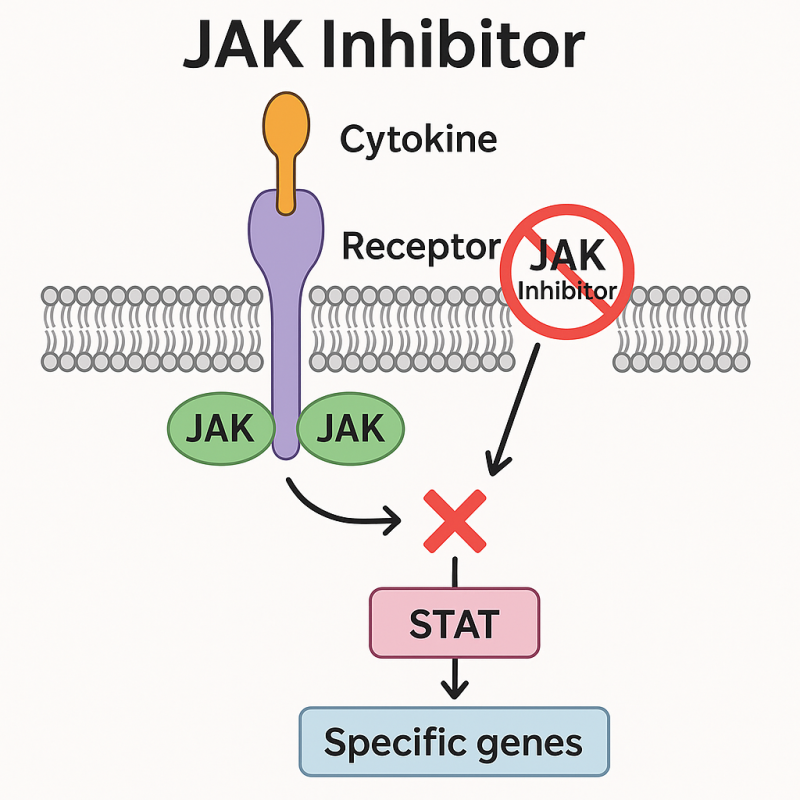
Because the JAK-STAT pathway is important in maintaining inflammation and forming granulomas, scientists and doctors have developed medicines that block this signalling. These medicines are called JAK inhibitors. They prevent JAK proteins from being activated, interrupting the signalling chain.
Some currently known JAK inhibitors are:
Tofacitinib, which blocks JAK1 and JAK3 and has been used experimentally in cutaneous forms of sarcoidosis.
Ruxolitinib, which blocks JAK1 and JAK2 and has shown positive results in pulmonary sarcoidosis in several cases.
Baricitinib and upadacitinib are also being investigated for various autoimmune diseases, including sarcoidosis.
Corticosteroids have so far been the main form of treatment.
Conclusion: what does this mean for patients?
In short, the JAK-STAT pathway is like an electrical switch that relays instructions from cytokines to the genes controlling the behaviour of immune cells. In sarcoidosis, this switch remains “on”, causing persistent inflammation. Modern medicines, JAK inhibitors, act like an insulator that interrupts this harmful signalling and gives the body a chance to return to balance.
For people with sarcoidosis, particularly those with severe and persistent forms of the disease, JAK inhibitors represent new hope. Although they are not yet widely approved for this disease, the results of studies and clinical cases so far suggest that they could become an important part of treatment in the near future.
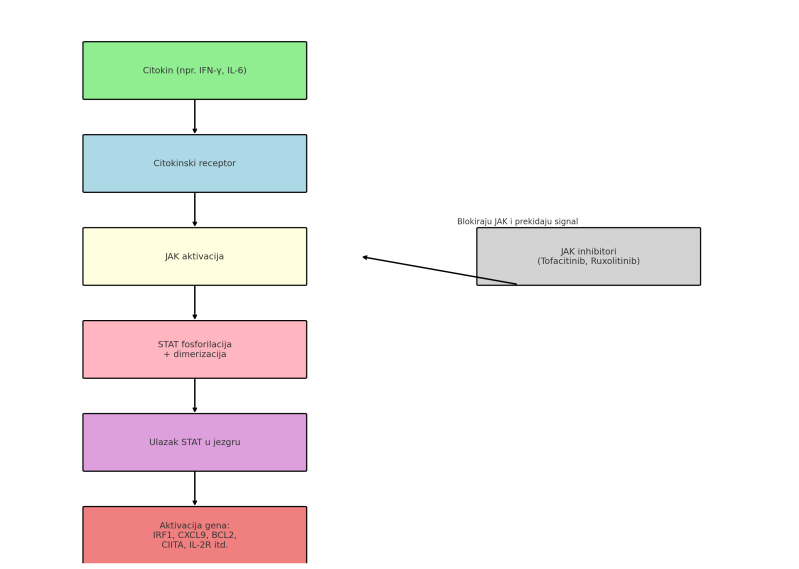
The diagram shows how the JAK-STAT signalling pathway works:
The signal starts when a cytokine such as IFN-γ or IL-6 binds to a receptor.
This activates JAK proteins, which then activate STAT proteins.
STAT enters the nucleus and activates specific genes, such as IRF1, CXCL9, BCL2, CIITA and IL-2R.
Modern JAK inhibitors, such as tofacitinib and ruxolitinib, block this signalling and thereby interrupt the inflammatory response.
Dino-Josip Ključarić, mag.theol.